I copied the wording from the filing so that we can better understand what is being said. As an unrepresented claimant, this response is very important because I have been asking the Trust if they have copies of all of the original reports of CSA by BSA counsels, because these original reports were never allowed to be subpoened. If the Trust does not have the original claims, then how can they accurately determine how many reports of abuse the Scout Leader actually has against them?
Also are they allowing reports that qualify as past the statutute of limitations to be counted towards the abuser’s talley? Or are they dismissing those counts under that statute of limitations disqualification?
Here is the Trustees filing, and none of my questions or statements constitute legal advice.
BACKGROUND
I. The Document Repository
The Document Repository was created pursuant to the Plan Appendix. See Plan App’x § 16. The Document Repository is intended to be “the foundational discovery that the holder of a Direct Abuse Claim will likely need to establish the validity and/or amount of their claim in order to obtain compensation under the Plan.” Id. The contents of the Document Repository primarily come from three sources. First, pursuant to the Plan Appendix, Debtors were required to provide certain documents to the Trustee, which were ultimately included in the Document Repository.
See Plan App’x § 1. These documents include the following:
- Documents produced in connection with the Chapter 11 Cases that relate to the
Abuse Claims, including all Rosters produced by Local Councils; - Documents pertaining to Abuse Claims that were open and unresolved as of the
Petition Date that are in the possession of Debtors’ National Coordinating Counsel,
Ogletree Deakins; - The Volunteer Screening Database (“VSD”) to the extent it relates to sexual abuse
in Scouting;2 – 2 The VSD files identify volunteers who were removed from BSA’s scouting programs based on violations of BSA policies (or suspected violations), including allegations of abuse. https://scoutingwire.org/bsas-call-to-establish-a-
nationwide-volunteer-screening-database/. The VSD files sometimes identify the victims of abuse. - Documents necessary to secure the benefit of any insurance rights;
- Certain categories of other documents to the extent they were in the possession of Ogletree Deakins including, but not limited to, documents regarding the registration of all identified alleged perpetrators identified in a Proof of Claim, yearly versions of Youth Protection Guidelines and other BSA policies and procedures, and all Rosters.
See Plan App’x § 1.
Second, under the terms of the Plan Appendix, Local Councils were required to produce certain categories of documents to the Trustee. See Plan App’x § 2. These materials included:
- Any evidence of insurance that could provide coverage for Abuse Claims and documents necessary to secure the benefit of any insurance rights;
- Complaints, reports, files, or any similar documentation related to any VSD files (or the equivalent) related to sexual abuse in Scouting or by a Scout leader or volunteer.
Id. Additionally, as the Trust processes and evaluates Claims, the Plan Appendix permits the Trust, through the form of informal document requests, to request that the Local Council provide copies of Rosters that are related to particular Claims. Id. These requests may be initiated sua sponte by the Trust or at the request of a Claimant. Id.
Collectively, there are approximately 210,000 documents in the Document Repository that originated from Local Councils.
Third, the Document Repository contains approximately 1,800 documents provided to the Trust pursuant to Court order by Pachulski Stang Ziehl and Jones, which represented the Tort Claimants’ Committee in the bankruptcy proceedings. See Order Granting Motion of Pachulski, Stang, Ziehl & Jones LLP Motion Pursuant to the Supplemental Findings of Fact and Conclusions of Law and Order Confirming the Third Modified Fifth Amended Chapter 11 Plan of Reorganization (with Technical Modifications) for Boy Scouts of America and Delaware BSA, LLC and 11 U.S.C. § 105(a), for Entry of an Order (I) Authorizing Pachulski Stang Ziehl & Jones LLP to Transfer Database to the Settlement Trustee and (II) Granting Related Relief [D.I. 11361].
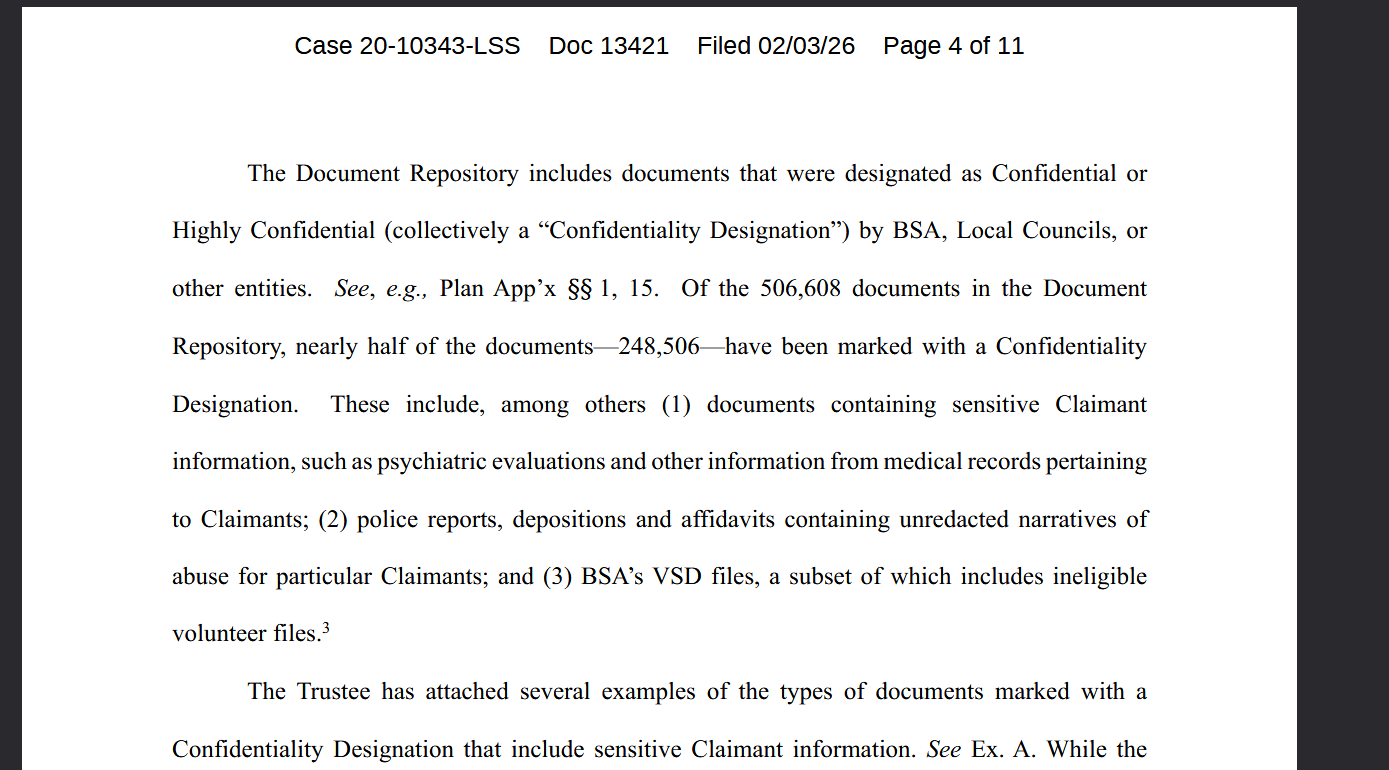
The Document Repository includes documents that were designated as Confidential or Highly Confidential (collectively a “Confidentiality Designation”) by BSA, Local Councils, or other entities. See, e.g., Plan App’x §§ 1, 15. Of the 506,608 documents in the Document Repository, nearly half of the documents—248,506—have been marked with a Confidentiality Designation. These include, among others (1) documents containing sensitive Claimant information, such as psychiatric evaluations and other information from medical records pertaining to Claimants;
(2) police reports, depositions and affidavits containing unredacted narratives of abuse for particular Claimants; and
(3) BSA’s VSD files, a subset of which includes ineligible volunteer files. 3 – 3 Under the terms of the Plan Appendix all VSD files are to be treated as Highly Confidential regardless of whether they were marked with that designation. See Plan Appendix at § 15
The Trustee has attached several examples of the types of documents marked with a Confidentiality Designation that include sensitive Claimant information. See Ex. A. While the Trust has redacted all identifying information from the versions attached to this Submission, for the avoidance of any doubt, these documents (and all other documents marked with a Confidentiality Designation) appear in unredacted form in the Document Repository—viewable to anyone with access to the database.
II. Relevant TDP and Plan Appendix Provisions Regarding Access to the Document Repository
Pursuant to the terms of the Plan Appendix, the Trust created the Document Repository to serve as a database containing “the foundational discovery that the holder of a Direct Abuse Claim will likely need to establish the validity and/or amount of their claim in order to obtain compensation under the Plan.” Plan App’x § 16. A separate section of the Plan Appendix governs Claimants’ access to the Document Repository. Specifically, Section 13 of the Plan Appendix states that “[h]olders of Direct Abuse Claims shall be entitled to access from the Settlement Trustee to documents and information they will likely need to in order to obtain compensation under the
Plan, provided, however, that holders of Direct Abuse Claims shall not be entitled to Privileged Information provided by the Debtors, Reorganized BSA, the Local Councils, and/or any Chartered Organizations to the Settlement Trust.” Plan App’x § 13.
Separately, in recognition of the fact that the Document Repository contains confidential materials, the Plan Appendix requires the Settlement Trust to take steps to protect the confidentiality of those materials and limits the circumstances under which the Trust can disclose or provide access to such materials. Plan App’x § 15.
Provisions of the TDP mirror the Plan Appendix’s language concerning Claimants’ access to the Document Repository. Specifically, the TDP states that the “Settlement Trust shall afford access for Direct Abuse Claimants to relevant, otherwise discoverable non-privileged information and documents obtained by the Settlement Trust pursuant to the Document Appendix to facilitate their submissions with respect to their Direct Abuse Claims.” TDP at Art. V.B.
III. The Trust’s Processes and Procedures Regarding Claimant Access to the Document Repository
The Trust has sought to establish processes and procedures for document access that appropriately balance its dueling obligations to provide Claimants with access to relevant documents and information in the Document Repository while simultaneously protecting the
confidentiality of materials within the Document Repository. With respect to represented Claimants, the Claimant’s counsel is provided access to the Document Repository if they sign a strict confidentiality agreement, which requires counsel to acknowledge, among other things, that their failure to comply with the terms of the agreement could expose them to sanctions and punishment in contempt of the Court-Ordered Confidentiality Provisions; civil and criminal liability; and referral to the attorney’s state licensing board and/or
applicable tribunal. See Ex. B, Confidentiality Agreement at ¶ 9. 4- 4 See 12.3 How Can Attorneys Access the Documents Repository?, Scouting Settlement Trust (Mar. 1, 2024 at 4:05 PM ET) https://www.scoutingsettlementtrust.com/s/article/How-Can-Attorneys-Access-the-Document-Repository Only the Claimant’s attorney is provided access to the Document Repository—the Claimant is not provided access, and the confidentiality agreement requires the attorney to seek permission from the Trust before disclosing any materials obtained from the Document Repository to the Claimant-client.
With respect to unrepresented Claimants, they also are not provided with direct access to the Document Repository. Instead, the Trust has established procedures through which unrepresented Claimants may request that the Trust search for relevant documents.5 – 5 See 12.2 How Can a Pro Se Claimant Access Information in the Document Repository?, Scouting Settlement Trust (Mar. 1, 2024 at 4:07 PM ET) https://www.scoutingsettlementtrust.com/s/article/How-Can-a-Pro-Se-Claimant- Access-Information-in-the-Document-Repository. In addition to protecting the confidentiality of documents by conducting the searches itself, the Trust has gained extensive experience navigating the Document Repository over the course of the past few years and is more experienced than anyone in doing so. Specifically, the Trust has a dedicated team of professionals who focus on Document Repository issues.
If the Claimant makes such a request, the Trust provides the Claimant with a description of the types of documents included in the Document Repository and a link to a Self-Directed Document Request form. See Ex. C, Self-Directed Document Repository Reference Materials; Ex. D, Self-Directed Document Request form.
That form permits the Claimant to provide information about his Claim,
- including his age at the time of his participation in Scouting and/or his abuse,
- the location and number of his troop (if known),
- the name and job title of his abuser (if known),
- or any other information the Claimant may recall regarding his abuser, including physical description.
Once submitted, the Trust uses the information provided in the form to conduct searches in the Document Repository for documents relevant to the Claimant’s Claim. The Trust uploads any relevant materials it discovers through these searches to the Claimant’s portal, so that the documents can be reviewed and considered as the Trust evaluates the Claim.
In addition, in two circumstances, the Trust conducts searches for materials relevant to an unrepresented Claimant’s Claim even if the Claimant fails to request that the Trust do so. First, where a Claimant provides adequate details identifying their abuser, the Trust will conduct searches of VSD files to determine if there are relevant materials that support the abuser’s connection to Scouting or the “Abuser Profile” aggravating factor. For example, Claimant S.C.— whose motion gave rise to the Court’s questions regarding Document Repository access 6 – 6 See S.C.’s Letter Regarding Settlement/Request to Compel [13288/13289].—never requested that the Trust conduct searches for any relevant materials. However, the Trust conducted
searches on its own and did not find any documents in the Document Repository that were relevant to his Claim.
Second, where the Claimant’s submissions do not provide adequate detail to establish the Claimant’s connection to scouting, the Trust will conduct searches for documents that may establish such a connection. To date, the Trust has run searches for 351 unrepresented Claimants at the Claimant’s request. The Trust has run searches for 653 unrepresented Claimants who did not request the Trust do so to better evaluate the Claimant’s claim.
Additionally, for both represented and unrepresented Claimants, solely for purposes of establishing a Claimant’s connection to scouting, the Trust will conduct outreach to the appropriate Local Council for available Rosters when it appears the Document Repository does not contain relevant information. For represented Claimants, the Trust will make the appropriate outreach when the Claimant’s counsel represents that he/she has been unable to find relevant documents and describes what search efforts they have undertaken to date. For unrepresented Claimants, to the extent that a Claimant makes the initial request that the Trust conduct searches for them and the Trust is unable to locate relevant information that establishes a connection to scouting (and the 8 Claimant has not otherwise provided documents sufficient to establish that connection), the Trust will make an outreach to the Local Council at the Claimant’s request.